Or, did you see those dresses?! AGAIN??!
Today is Yom Kippur, the Jewish day of repentance. Whereas Catholics can wander into the confessional whenever they feel like it, Jews save up all their sins and repent one day a year. I’m supposed to be devoutly in the synagogue, fasting and praying for forgiveness. Instead, I just ate four bowls of Lucky Charms and now I’m writing about Bridgerton. I’m so good at this!
Still, in honor of the holiday, I formally apologize to anyone I may have offended with these articles. Unless you’re someone I meant to offend, such as Neo-Nazis, those who love the movie Braveheart, or Henry Tudor.
With that out of the way, I’m here to talk about Queen Charlotte, A Bridgerton Story. Regular old Bridgerton takes place during the Regency Era, which follows the end of the Georgian Era and directly precedes the Victorian. It’s a time period I give exactly zero fucks about, and one I describe as “where fashion went to die.” In fact, there’s only one fashion style I hate more than regency: the modern mermaid skirt. In Georgian (also known as “Rococo”) style, the waistline is where it’s supposed to be – at your actual waistline. In Regency, it’s right below your tits. And a mermaid skirt has it at your fucking calves. Sorry, but my waistline should be right where the non-existent sky fairy put it. At my goddamn waistline.
ANYWAY, Queen Charlotte tells the story of Queen Charlotte, wife to George III, or at least the early days of their marriage. It’s a surprisingly dramatic story, even without the embellishment of a made-for-tv period romance. But, like I am wont to do, I’m here to break down fact from fiction, and, if you remember my article on Outlander, to fawn over my favorite fashion period. For reference, Outlander (at least the first few books/seasons) takes place about twenty years before Queen Charlotte, so they’re both Rococo.
I will give Queen Charlotte this: there’s a disclaimer at the beginning of the show that stresses that it’s historical fantasy, and as such, places more importance on good drama than historical accuracy. But if I didn’t focus on the accuracy, what else would I be good for?
Please don’t answer that.
Let’s just dive right in, then.
The Great Experiment
First, let’s get this one out of the way. No, there was no “Great Experiment.” High society, or even middle class society, in the mid 18th century was WHITE WHITE WHITE. So even if someone got it into their head that they wanted to integrate, there was no “Their” side or “Our” side. Queen Charlotte of Mecklenburg-Strelitz married George III in 1761, more than 50 years before the end of slavery in Great Britain. Even the catalyst of this idea, that Charlotte herself was Black or had Black ancestry was…well, I’m not sure what the right word would be, because there are real live historians who think there’s some basis to this theory.
The theory goes that Charlotte was Black, but various painters gave her white skin so as to not offend her or her family. The first person to float this idea did so way back in 1929, and claimed that she had this ethnicity because of descent from Madragana, a mistress of King Afonso III of Portugal from the early 1200s. Other evidence cited includes journal entries from people who met the queen and described her as having a “Mulatto” face.
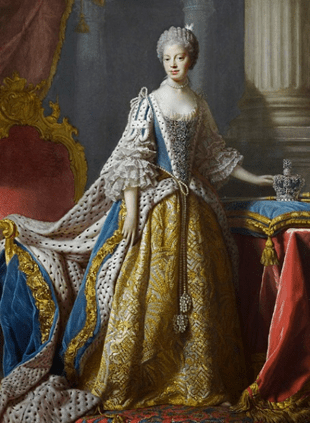
As I said, society in the mid 1700s was WHITE WHITE WHITE. There’s simply no way that a Black woman would be the daughter of the duke of Mecklenburg, Prince of Mirow, nor become the queen of Great Britain. Further, having a darker skinned Portuguese ancestress 15 generations back would not give someone darker skin as well. If it did, we’d be talking about Charlotte’s mother-in-law, Augusta.
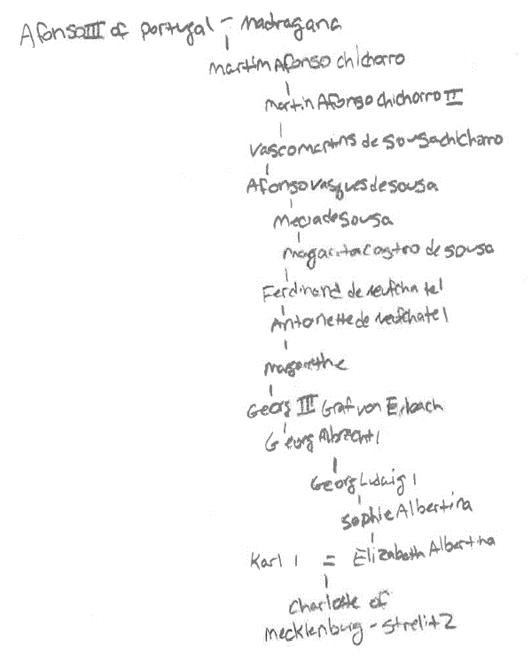
Supposed Portuguese ancestry of Charlotte of Mecklenburg-Strelitz
Because I am incapable of talking about any kind of European history without bringing up my sweetheart, John of Gaunt, let’s look back at the Hapsburgs and their Portuguese ancestry.
Both Joanna of Castile and her husband, Philip the Abuser Handsome were descended from John of Gaunt’s oldest daughter, Philippa, who married John I of Portugal. In fact, since the early Portuguese were super huge fans of incest, Philip was descended several times over from this marriage. It turns out that Augusta, Dowager Princess of Wales, was descended from Joanna and Philip through their son, Ferdinand, and his daughter, Maria. Maria’s marriage was actually really weird, and the sole source of Hapsburg blood into Protestant families, but I’ll get to that…someday. And yes, for sharp readers, that does mean that George III was an Ultimate Lancastrian.

By the Grand Unified Family (or GUF) that I’ve introduced previously, this descent also means that Augusta was descended from Peter of Portugal and his (beheaded) mistress, Ines de Castro.

The overall point here is that, of the two women, Augusta had significantly more Portuguese descent – at least that I can verify – and yet no one has ever suggested she may have been Black. Granted, the genetics behind skin color are a bit complicated and the number of ancestors of color you may have doesn’t necessarily indicate skin color. But the fact remains that having ONE Portuguese ancestor FIFTEEN generations back is not evidence that Charlotte was Black. In my (not at all professional) opinion, there’s no way she was.
The Succession Crisis
Queen Charlotte bounces back and forth between the “present” (the Regency era) and the beginning of her marriage, 1761. In fact, the “present” can be exactly dated to 1817, as it covers the death of Princess Charlotte of Wales, Queen Charlotte’s granddaughter. This was a real event that kicked off a succession crisis because she was, at the time, the only heir to the throne as Charlotte and George’s only legitimate grandchild.
Despite having thirteen children survive to adulthood, by the time George III went permanently insane, only one, George, had legally married and had a child, the aforementioned Charlotte. With her death in childbirth, the country was left with a real problem on their hands.
Note: Charlotte didn’t just die in childbirth. Her death was a freak horror show – she started hemorrhaging, and the proper treatment of the time was bloodletting. Just let that sink in for a bit. And then be really really glad you live today. We may have horrible fashion choices, but at least we don’t have to face that!
Unlike the show, however, the queen wasn’t forced to strongarm her remaining children into proper marriages. Yes, several of them had taken mistresses and married them on the side – marriages that would have been considered illegal. But Parliament promised each of them significant increases to their allowance if they married, and if they managed to knock up their fancy new wives, they could expect a life of riches as the parents of a monarch. Several of the princes jumped at the chance and secured unions with qualified European royal women.
In the end, the first son to marry and produce a kid was Adolphus, Duke of Cambridge. But because he was a younger son, Edward, Duke of Kent and Strathearn and his wife, Princess Victoria of Saxe-Coburg-Saalfeld, took precedence and their daughter, Alexandrina Victoria, became the heir and eventually took the throne as Queen Victoria. Unfortunately, succession in Hanover, which had been ruled by the kings of Great Britain since the Hanoverian Succession in 1714 (see Outlander), followed Salic Law, which meant Victoria could not become queen there in her own right. Edward’s younger brother (but still older than Adolphus), however, Ernest Augustus, managed to knock up his wife, Friederike of Mecklenburg-Strelitz (her mother-in-law’s niece), and their son, George, became George V of Hanover. Neither Adolphus nor Ernest Augustus, are portrayed by name in Queen Charlotte.

And just as a reminder, yet again, of how inbred everyone was, George V’s wife, Mary of Teck, was descended from George III as well. In addition, Queen Victoria and her husband, Prince Albert, were first cousins, and George IV’s daughter, Charlotte, married into the family, too.

The Madness of King George
GIANT DISCLAIMER GIANT DISCLAIMER GIANT DISCLAIMER
I am not a licensed psychologist, psychiatrist, clinician, or any sort of mental health expert. I’m simply someone who reads a lot and has a significant amount of experience in mental health herself. Everything written below is purely my opinion and should be interpreted as such. Too many real historians have approached the topic of mental health in various monarchies with a clinical eye rather than one of empathy, and that is, in my opinion, cruel and a disservice to history. Please take this section as intended – an attempt at understanding, acceptance, and compassion.
Common opinion used to hold that George suffered from acute intermittent porphyria, a genetic disorder that renders sufferers temporarily unable to process porphyrins, which are breakdown products in the blood. During an attack, sufferers can experience pain, vomiting, confusion, and various other really shitty symptoms. The easiest way to diagnose acute intermittent porphyria is by exposing someone’s urine to UV light. During an attack, the urine will turn purple.
The idea that George suffered from porphyria was floated by a mother/son team in the 1960s based on extremely selective data, which essentially included the fact that his piss was occasionally blue and one of Victoria’s great grandchildren, Feodora of Saxe-Meiningen, might have had the disease. It doesn’t take an expert to point out that blue is not purple, and there’s no indication that his urine was ever exposed to sunlight. Instead, the color change can be explained by a medication he was given during his “fits.” As for Feodora of Saxe-Meiningen, not only was the DNA testing inconclusive for porphyria, too many generations had elapsed by that point for the data to be relevant anyway.
Thankfully, common opinion has now largely shifted and the generally accepted explanation is that George suffered from bipolar disorder. And this is where my own experience comes into play.
George’s first instance of mental illness may have come in 1765, a few years after his marriage. But his first confirmed “fit” came decades later in 1788. He would speak for hours at a time, sometimes foaming at the mouth. His writing would become increasingly complex, and he would lose touch with reality, which is the definition of psychosis. Suffice it to say, his symptoms during these fits sound entirely plausible as bipolar manic phases. Having suffered several myself, I can tell you that bipolar affects every person differently. My manic phases involve panic attacks, screaming, and incessant crying. I don’t experience psychosis, but many people do. While there are no records that indicate George would wander gardens naked at night, screaming at the moon, it’s not out of the realm of possibility. He suffered several relapses over his life, and in 1811 relapsed for the final time. He never recovered. The Regency Era is so named because by that time, his eldest son, George, permanently became regent until the king’s death in 1820.
George was treated by a Doctor Monro, though this didn’t happen until much later in life. For most of his life, he was treated by Francis Willis, who did tie him to a chair and torture him.
I was going to go into a lengthy analysis of the mental health of Victoria and her descendants as further proof that George may have suffered from bipolar, but that’s too far outside my wheelhouse. Queen Charlotte never specifies what George suffered from, but the show approaches the situation with an overwhelming amount of kindness and understanding, portraying him as fully deserving love. Honestly, it made me cry. I give it a bazillion stars.
Family Drama Drama Drama
I have to admit that I have not read enough about Dowager Princess Augusta or Queen Charlotte to weigh in on whether Augusta was a giant bitch or Charlotte was such a tour de force with her family. I do find it hilariously appropriate that Michelle Farley was cast to play Augusta, as she also played Margaret Beaufort on (UNDERLINE)The Spanish Princess. For those readers who have been along for the ride with me, you may remember that I hate Margaret Beaufort, and seeing her play a bitchy Augusta was just delightful.
I started reading a biography of George III, but had to stop partway through because the author focused so much on Parliament and Prime Ministers (Lord Bute was a real dude, FYI) that I couldn’t keep track of George-related things. I did get far enough in to determine that George really was a super nerd, though, so I can confirm that. George and Charlotte enjoyed a love match, though unlike the show, it began as soon as they met.
What I can also confirm is the Hanoverians in general were just nasty to each other. George II and his wife, Caroline of Ansbach, despised their eldest son, Frederick. George I split with his wife, Sophia Dorothea of Celle, and had her locked up in a castle for the last thirty years of her life. Charlotte couldn’t stand her oldest son, George IV, and George IV and his wife, Caroline of Brunswick-Wolfenbuttel, also hated each other. She left Britain shortly after the birth of their only child, and only heard about her death in passing, as George refused to tell her. George also refused to have her crowned queen, and wouldn’t even receive her in London when she returned to the country.
In addition, Victoria had a terrible relationship with her mother, the Duchess of Kent, as the Duchess had come under the influence of John Conroy, an adviser who attempted to assure his ability to rule Great Britain through Victoria. As a result, Victoria felt suffocated growing up, and the Duchess came into direct opposition with William IV when she refused to allow the king and princess to contact each other. The Duchess and Victoria were able to repair their relationship when Victoria became queen, once Conroy was finally dismissed.
Brimsley and Reynolds
Two gay people in 18th century London falling in love? Impossible. Didn’t you know gay men were invented by RuPaul in 2008 in order to sell drag to little kids?
Fucking hell, I’m pretty sure there are real people out there who actually believe that.
Of course this is possible. Brimsley and Reynolds are made up, but this is a totally plausible scenario. Homosexuality was extremely forbidden in society, but that doesn’t mean they didn’t exist. Hell, this is around the same time as the reign of Frederick the Great, one of the most powerful people to rule in Europe…ever. And historians are pretty sure he was flaming.
Gay people exist. Gay people have always existed. And it’s great to see this kind of plot becoming mainstream on TV.
Oh no, does that mean I’m too woke? Dear reader, did you just figure that shit out? Took you long enough.
THE DRESSES
As previously mentioned, Queen Charlotte takes place during the Rococo period. The dress seen most often on screen is the robe a la francaise, also known as the sacque back dress. This version featured an open gown in the front with a heavily detailed stomacher, petticoat, and sort of cape in the back. It was frequently called the “pet-en-l’air” which is French for “fart in the air.” I’m not kidding. A story holds that when Madame de Pompadour, the famous mistress of French King Louis XV, wore this gown for the first time, one of her ladies farted. She found it so hilarious that she named the gown after the incident. This also makes Madame de Pomadour one of my all-time favorite people, because I am in fact four years old.
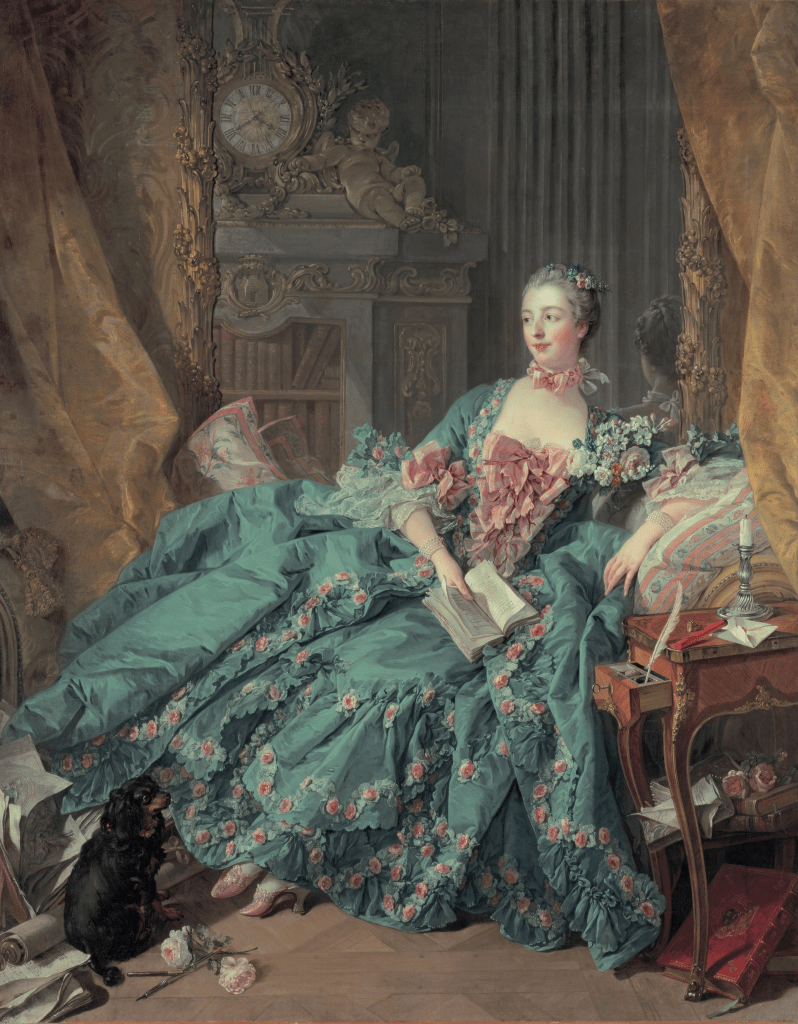
For a better description of robes a la francaise, I heavily recommend you check out American Duchess, a blog all about 18th century fashion. As for Queen Charlotte, I only have two complaints.
In the first few minutes of the first episode, Charlotte complains that her corset is too tight. This is a very common misconception, though at this point I suspect writers know they’re wrong and they choose to include this trope for style rather than historical accuracy. Women did not start tightlacing corsets until the end of the Victorian Age. They had no reason to, as fashion did not demand it, and women weren’t stupid.
In addition, Charlotte explains that her corset is full of sharp whalebone, and if she bounces, she will stab herself. This is also a common misconception, as corsets of the time were made with whale baleen, not bone. Baleen was light and flexible, a major step up from the spring steel previously used. Bone would have been far too brittle and, yes, sharp. Again, women weren’t stupid, and an article of clothing that likely to stab the wearer wouldn’t have been used. So, Charlotte would have been free to bounce away, satisfied in knowing that her corset was not likely to kill her.
Other than that, I loved every minute and I want every single dress.
Recommendations
I have a tendency to shit pretty hard on historical fiction. You know my opinions on Braveheart, and I couldn’t stand The Spanish Princess. I still refuse to watch Reign, and The Other Boleyn Girl…
Well, I have high expectations.
But Queen Charlotte? I liked it. I really liked it. I might even go out on a limb and say I loved it. Yes, it had a bunch of historical inaccuracies, but they were made for good reason and someone can watch it and still learn a thing or two about real history.
I’ll leave you with one last parting fact.
One of the last lines of the show is Charlotte reassuring George that his line – which he corrects to their line – will go on. Through Queen Victoria alone, Charlotte and George’s blood flows through the following royal houses:
- Denmark
- Germany
- Greece
- Norway
- Romania
- Russia
- Spain
- Sweden
- The United Kingdom
- Yugoslavia
That’s almost half of all the European royal houses, including the pretenders. In addition, the House of Hanover, in the male line, continued through their son, Ernest Augustus. That line continues today with Ernst August, the Hereditary Prince of Hanover.
Their line didn’t just go on. Their line, and their love, spread across Europe and endures today in every corner of the Western world.
If you really want to contact me on Twitter (I refuse to call it X), you still can, but you can also leave comments here. And if you’re being a better Jew than I am and are fasting for Yom Kippur, may it be easy and may your new year be good!
 Rhydnara the Viking