Or, so long, Margarethe
I talk about England. A lot. I’m aware of this. But the truth is, the country I’m really obsessed with is Denmark. Denmark’s role in World War II saved 99% of its Jewish population, and their Viking history is pretty cool, too. Denmark is consistently rated as one of the happiest countries in the world, and if it weren’t for the fact that they banned pit bulls (my favorite dog breed), I’d say the Scandinavian country is my utopia. Oh, also, except for the fact that the only way I’ll ever get Danish citizenship is if I marry Prince Joachim, younger brother of Crown Prince Frederik, soon to be Frederick X.
And that’s why I’m writing this today. Not because I’m pining for my Danish prince (ok, yes I am. I am constantly pining for my Danish prince), but because tomorrow, the world will say goodbye not just to Danish Queen Margrethe II, but to one of the oldest royal houses still in existence. Sort of.
Margrethe has announced that she is abdicating – a fancy royal term for retiring – and her oldest son, Frederik, will assume the throne. But this isn’t just the passing of the crown from one monarch to another. This is the passing of one royal house to another. Margrethe is the last Danish monarch from the House of Oldenburg – an old, old Germanic house that stretches back to before the Norman Conquest.
The House of Oldenburg came to prominence with the election of Count Christian I to the Danish throne in 1448, and later to the Swedish and Norwegian thrones when the three countries were united in the Kalmar Union. The Kalmar Union didn’t last long, but the Oldenburgs remained on the Danish throne for the next 576 years. Margrethe is descended from a minor branch, the Dukes of Schleswig-Holstein-Sonderburg-Glücksburg (something I refused to write over and over again, which is why it appears as S-H-S-G on the chart). This line at various times came to control the duchies of Schleswig, Holstein, Sonderburg, Glücksburg, and Beck.
The main line of Oldenburg Danish kings ended with Frederick VII in 1863, at which point a distant cousin, Christian, the aforementioned Duke of Schleswig-Holstein-Sonderburg-Glücksburg, was chosen as his successor. This Christian, now Christian IX, was also married to Louise of Hesse-Kassel, a cousin of Frederick VII.
Margrethe II is Christian IX’s great-great granddaughter, and the last of her line. She married Henri de Laborde, Count of Montpezat. The soon-to-be Frederik X will officially still be of the House of Oldenburg (well, Schleswig-Holstein-Sonderburg-Glücksburg), but realistically he will be from the House of Montpezat. You can’t really lie about genetics.

And about that citizenship thing? He married Mary Donaldson, an Australian whom he met in a Sidney pub during the 2000 Olympics. Denmark had to pass a special law, called Mary’s Law, in order for her to gain Danish citizenship so she could marry him. So yeah, my hopes of getting Danish citizenship are nil. But I wouldn’t be able to bring my pit bull, Sigrun, so I suppose it doesn’t matter in the end.
Breed specific legislation is harmful, wrong, hateful, and doesn’t work. Pit bulls are wonderful. Their heads are full of rocks but their hearts are full of love and you will never regret adopting one. Sigrun saved my life when I lost my previous dog, Bryn.
But back to the House of Oldenburg. While it may be off the Danish throne, it still continues on the Norwegian and British thrones, continues on the pretend throne of Greece, and continued up until the Socialist Revolution in Russia.
The British, Norwegian, and Greek thrones descend from Christian IX, as shown below. For Charles III of Britain, legally speaking he is from the House of Windsor, as the UK passed a law during his mother’s reign that said any future monarch, regardless of gender or parentage, would be from the House of Windsor. But genetically speaking, Charles is from his father’s house. Legally speaking (they tried to get around genetics a few times), Philip, Duke of Edinburgh, was from the House of Mountbatten, his mother’s family. But again, genetics doesn’t lie. Philip’s father was Prince Andrew, a male line grandson of Christian IX of Denmark.
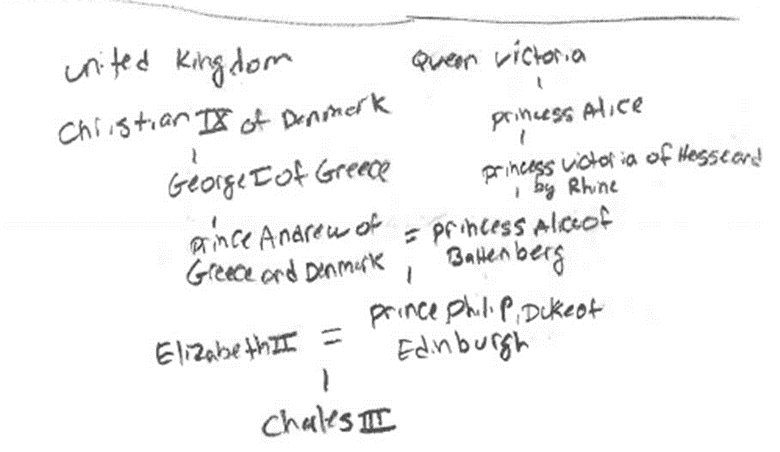
King Harald V of Norway is a male line great-great grandson of Christian IX of Denmark.
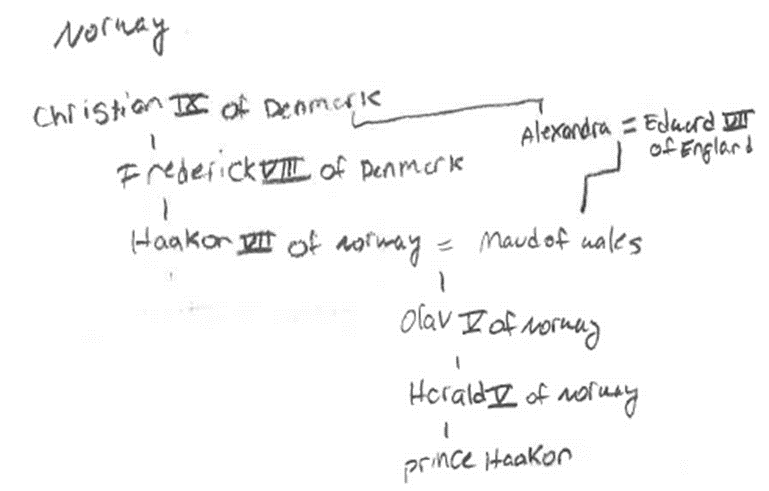
The current pretender to the Greek throne, Crown Prince Pavlos, is a male line great-great-great grandson of Christian IX of Denmark. Christian IX of Denmark’s kids kind of got around.

The Russian throne gets a bit complicated, for a number of reasons. Adolf, Duke of Holstein-Gottorp, was a younger son of Frederick I of Denmark. His male line descendant, Charles Frederick, married Anna Petrovna, the younger daughter of Peter the Great. Peter’s older daughter, Empress Elizabeth, chose Anna’s son, Peter, as her heir and had him married to Sophie of Anhalt-Zerbst – better known as Catherine the Great. Peter III, as he became known when he became emperor, more or less refused to bed his wife, so Catherine was forced to find “other ways” to give Empress Elizabeth an heir. Catherine heavily suggested in her memoirs that her son, Paul, was really the son of Sergei Saltykov, though she later retracted this and many people observed that Paul looked a lot like Peter III.
The Russian royal family continued to use the name Romanov, but in terms of genetics (assuming Paul really was the son of Peter III), the royal family was from the House of Holstein-Gottorp – AKA, the Oldenburgs. The empire officially ended with Nicholas II and his murdered family (OTMA stands for Olga, Tatiana, Maria, and Anastasia – his four daughters), but there are still male line descendants. It’s debatable who the rightful pretender to the throne is at the moment, but I’m not going to get into that mess right now.
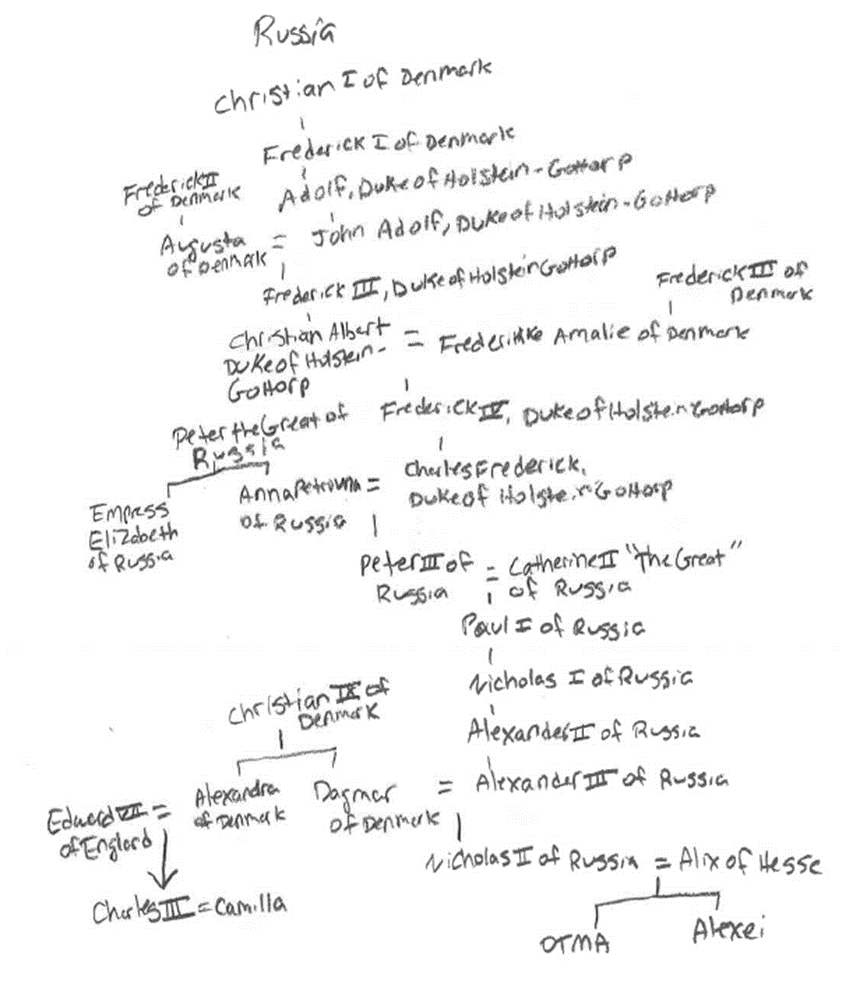
At the end of the day, the House of Oldenburg is still alive and well, though not everyone admits it and not everyone who claims it is telling the truth. As for Margrethe II, I can only wish her well in her retirement. She had a very small chance of passing Elizabeth II’s record for longest reign of a female monarch, but alas it appears that shall not be.
I’m still going to fantasize about my Danish prince. Maybe in my dreams he can change the law to allow pit bulls.
 Rhydnara the Viking
You may have had too many King Christians and Fredericks to shuffle through to clearly recall my fourteenth great grandfather, Hans von Oldenburg, son of Christian I. Hans was Denmark’s King following his father’s death. King Christian II was the son of King Hans and Christina von Sachsen (sister to Frederick the Wise, Luther’s protectorate). I think the shift to Schleswig-Holstein happened with Christian II following King Hans death. His great love, Adele Mikkelsdatter Jernskaeg, poor nobility and lady in waiting to Christina von Sachsen, is the matriarch in my lineage. I’m interested in knowing more of these two. Traveled to ancestral grounds this summer. Most museums I visited refer to this period, the reign of Hans, and pre-Reformation, as “pre-history.”
LikeLike